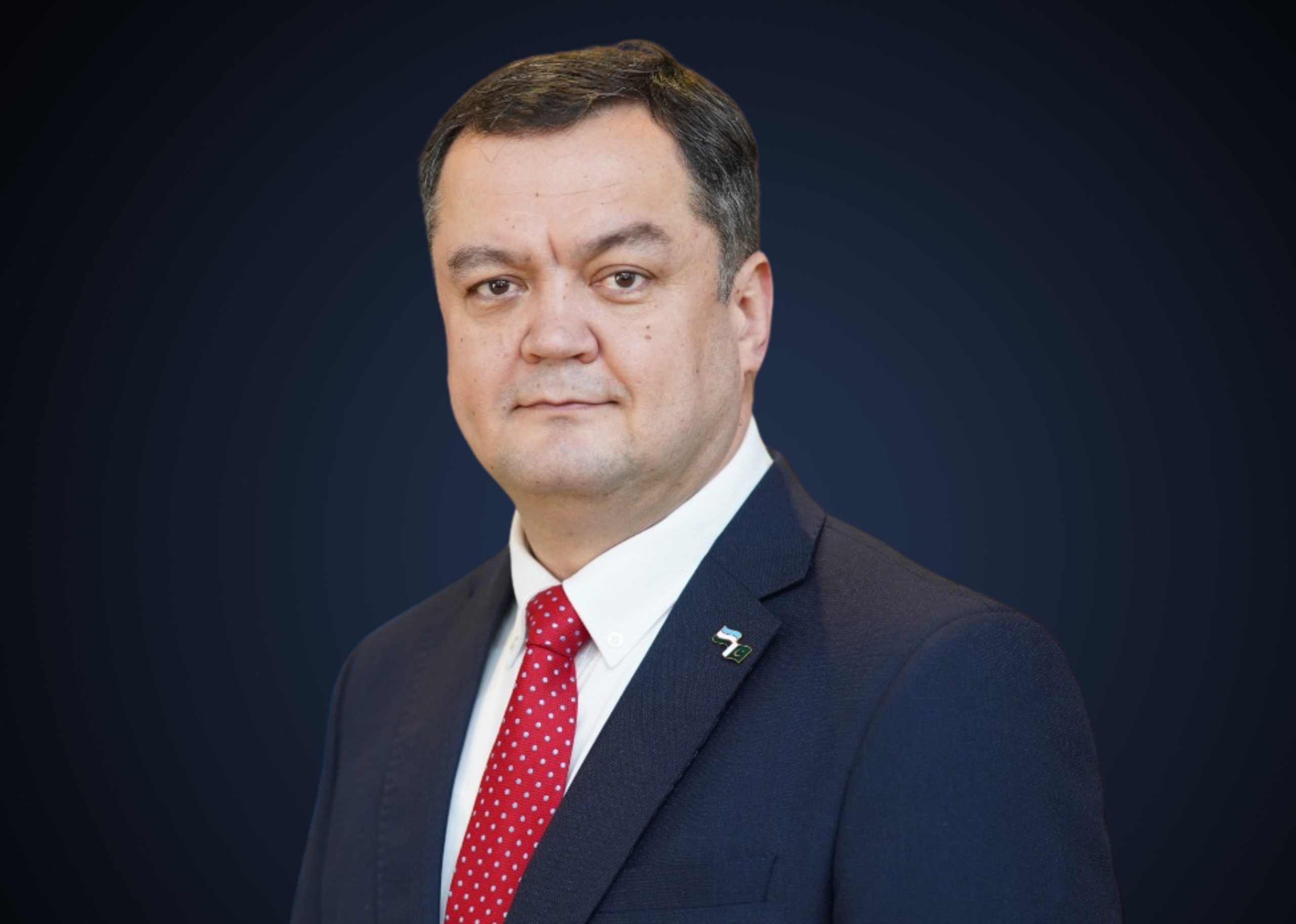
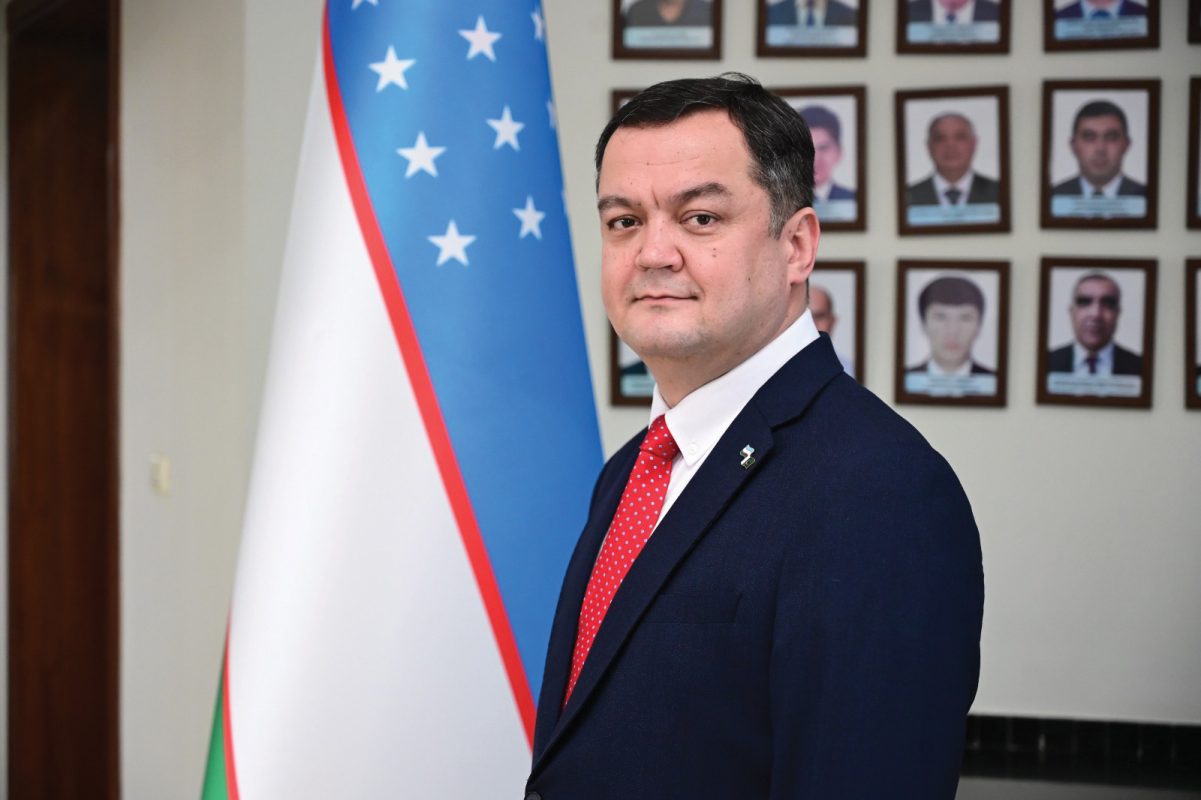
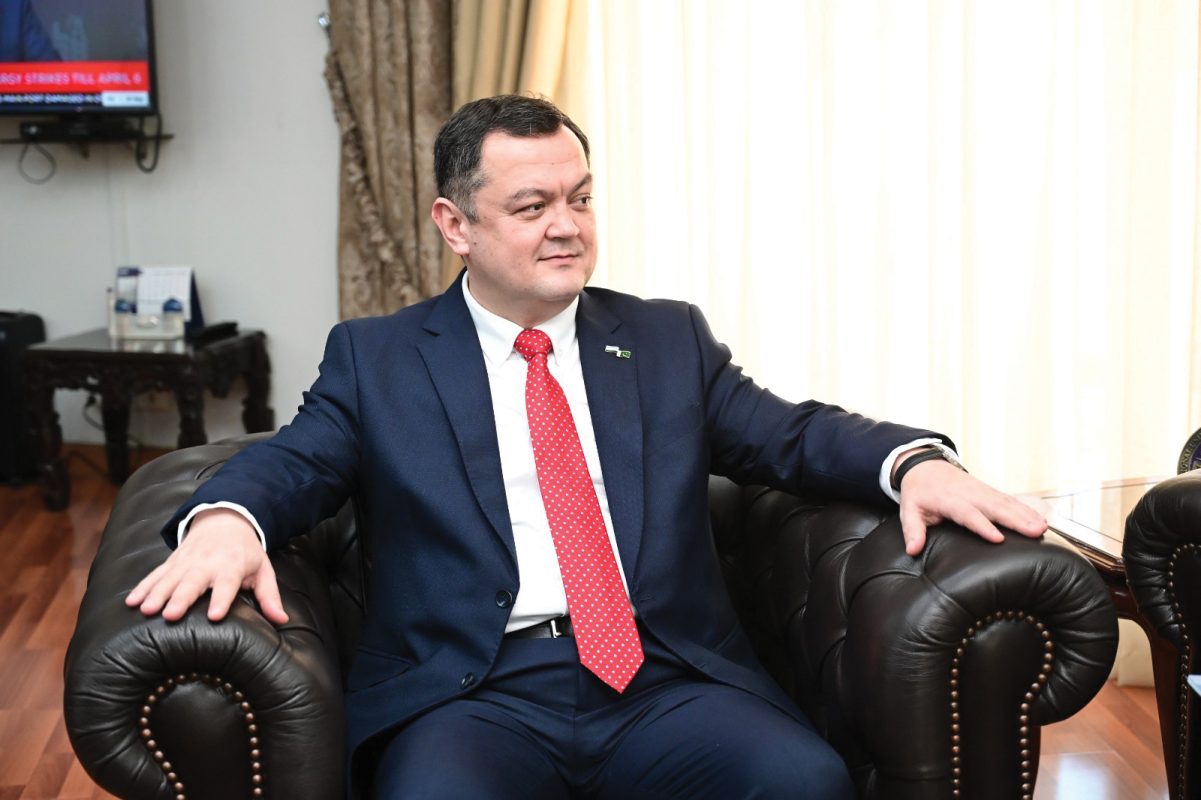
H.E. Mr. Alisher Tukhtaev (Ambassador of Uzbekistan to Pakistan)
H.E. Mr. Alisher Tukhtaev is a graduate of Tashkent State Institute of Law. He has held various senior positions at the Ministry of Foreign Affairs, Institute for Strategic and Interregional Studies under the President and the Presidential Administration. He also previously worked at the Association of Cotton and Textile Clusters of Uzbekistan, first as an advisor and then as Deputy Chairman.
What inspired you to choose a diplomatic career and how your journey to this position unfolded?
My decision to pursue a diplomatic career was primarily driven by my interest in International Relations and my desire to serve as a bridge between different peoples and cultures. Even during my school years, I was interested in global politics, geopolitical processes, and issues of cooperation between states. I also regularly followed international developments through reading and media channels.
After Uzbekistan gained independence, the emergence of a new foreign policy direction based on openness and mutually beneficial cooperation greatly inspired me.
Throughout my professional career, I have held various positions within the system of the Ministry of Foreign Affairs of Uzbekistan, gaining extensive experience in cooperation with international organizations and foreign countries. My role as Ambassador of Uzbekistan to Pakistan is a logical continuation of this experience, focused on further strengthening the strategic partnership between our two brotherly nations.
What qualities should an effective diplomat possess?
I believe that a modern diplomat must be capable of strategic thinking, adapting quickly to rapidly changing circumstances, and possessing strong communication skills. In addition, they must have a deep understanding of different cultures and values. Studying and respecting the mentality of the country where one serves is also one of the subtle yet essential aspects of diplomacy.
Moreover, patience, responsibility, and professional competence are of great importance. Diplomacy, after all, is the art of building long-term trust and cooperation.
How is the role of diplomacy changing in the global environment?
Today, diplomacy has expanded beyond traditional political dialogue and now encompasses economic, digital, and cultural spheres as well. Competition and cooperation between states are taking on new forms.
Therefore, diplomats are now required to possess diverse knowledge and skills. A modern diplomat must not only be a politician, but also an economist, an analyst, and someone proficient in information technologies.
In the current era of global uncertainty, diplomacy is taking on a central role. It is true that, in some cases, even diplomatic dialogue proves insufficient in resolving conflicts between states. However, Uzbekistan consistently advocates for the peaceful and diplomatic resolution of disputes between parties. Therefore, we strive to address all issues through diplomatic channels, and the entire world is witnessing the results of our efforts.
Let me provide an example: until recently, the Central Asian region, where Uzbekistan is located, had been living amidst various challenges. It is no secret that countries in the region held differing positions on border, water, and other issues, which often led to disputes. After Shavkat Mirziyoyev was elected President of Uzbekistan in 2016, priority was given to eliminating all existing barriers with neighboring countries. Through diplomatic dialogue, Uzbekistan managed to resolve longstanding issues, including complex disputes related to water resources and borders that had remained unsettled for many years. I consider this a clear demonstration of the effective outcomes of Uzbekistan’s global diplomacy.
How do you assess the current state of relations between Uzbekistan and Pakistan?
Uzbekistan and Pakistan have long been connected by historical and traditional ties of friendship, a shared religion, and similarities in customs, traditions, and cultural values. In recent years, these commonalities have become especially evident and have served as a “driver” for the development of socio-economic as well as cultural and humanitarian cooperation between the two countries.
In Pakistan, one can find many elements of Uzbek culture and lifestyle. As is well known, the territory of present-day Pakistan was once part of the Mughal Empire founded by our great ancestor, the commander and statesman Zahiriddin Muhammad Babur. The legacy of the Mughals can be seen in many parts of Pakistan, particularly in the city of Lahore. The gardens, fortresses, mosques, madrasas, and water structures built by them have become an integral part of Pakistan’s cultural heritage. The people of Pakistan take pride in this legacy and hold the Mughal heritage in high regard. In this sense, historical connections and shared heritage serve as a solid foundation for the development of modern relations between Uzbekistan and Pakistan.
Geographically, Uzbekistan is located at the heart of Central Asia and shares borders with all countries in the region.
Pakistan, in turn, occupies an important logistical position. It hosts strategically significant transport corridors that provide access to the Indian Ocean. These corridors are considered vital arteries for transport connectivity among some of the world’s most populous countries.
Moreover, Pakistan holds a central geographical position in South Asia. In this regard, Uzbekistan and Pakistan can serve as a unique bridge between Central and South Asia.
I would also like to emphasize another point: both Uzbekistan and Pakistan are lands of great civilizations. We share many historical roots and similarities. Most importantly, today we are good friends and partner countries.
At present, relations between Uzbekistan and Pakistan are developing dynamically on the basis of a high level of trust and mutual respect. In recent years, regular dialogue at the level of heads of state, high-level visits, and strategic agreements have elevated bilateral relations to a new stage. This progress is clearly visible not only in political dialogue but also in economic and humanitarian spheres.
At the same time, cooperation between the two countries is not limited to bilateral relations but also carries regional significance. Uzbekistan and Pakistan play an important role in strengthening connectivity between Central and South Asia, which further enhances the strategic importance of their partnership.
Diplomats are now required to possess diverse knowledge and skills. A modern diplomat must not only be a politician, but also an economist, an analyst, and someone proficient in information technologies.
On February 5–6 of this year, President of Uzbekistan Shavkat Mirziyoyev paid a state visit to Pakistan. Could you comment on the outcomes of the visit?
This was truly a historic visit. Naturally, the question arises: what practical results did this historic visit yield?
First of all, the visit served to further strengthen the bonds of friendship and mutual understanding between Uzbekistan and Pakistan. In particular, it gave new momentum to the development of regular political dialogue based on trust between our leaders.
Secondly, during the visit, a Joint Declaration was signed by the President of Uzbekistan and the Prime Minister of Pakistan. In addition, more than thirty bilateral documents were signed with the participation of the leaders of both countries. These figures clearly demonstrate how productive the visit was.
Thirdly, very important agreements were also reached in the fields of trade and investment.
Fourthly, cooperation between our peoples in the cultural, artistic, and scientific spheres is also developing rapidly. This directly supports people-to-people diplomacy.
In particular, the naming of one of Islamabad’s central streets as “Tashkent Street” and the opening of a new park named after our great ancestor Zahiriddin Muhammad Babur have become symbols of historical closeness and our shared spiritual values.
The President of Uzbekistan was awarded honorary Doctor and Professor titles by the National University of Science and Technology. In addition, our Head of State was presented with Pakistan’s highest state award – the “Nishan-e-Pakistan” order. As our President emphasized, this prestigious award reflects the friendly attitude and deep respect toward the people of Uzbekistan.
The Government and people of Uzbekistan highly appreciate the state visit to Pakistan and believe that it fully justified the expectations placed upon it.
Taking this opportunity, I would like to express my sincere gratitude to the Government and people of Pakistan for the warm hospitality and high-level attention extended to the Uzbek delegation during the visit.
Uzbekistan and Pakistan have long been connected by historical and traditional ties of friendship, a shared religion, and similarities in customs, traditions, and cultural values.
What are your main priorities during your activities in Pakistan?
One of my main priorities is to expand trade and economic cooperation and elevate it to a qualitatively new level. In this regard, special attention is being paid to organizing business forums, establishing direct contacts between entrepreneurs, and improving the investment climate.
At the same time, developing cooperation in the transport and logistics sector is also an important priority. Considering Uzbekistan’s limited access to the sea, the development of new trade corridors through Pakistani ports remains one of the key tasks.
We are also facing pressing objectives such as deepening industrial cooperation, expanding energy partnerships, accelerating digital transformation processes, and strengthening interregional ties. However, the greatest asset of our cooperation is mutual trust, open dialogue, and a strong political will to move forward together.
Could you elaborate on the current state and prospects of trade and economic cooperation between our countries?
Expanding trade and economic ties has been identified as one of the priority areas of Pakistan–Uzbekistan dialogue. The implementation of the Trans-Afghan railway project is of strategic importance for both Tashkent and Islamabad. It will not only increase the volume of mutual trade and the number of joint ventures, but also accelerate trade and investment flows between Central and South Asia.
As a result of systematic efforts, bilateral trade volumes have shown dynamic growth over the past eight years, increasing nearly 12-fold. As of January 1, 2026, this figure reached 475 million US dollars. In accordance with high-level agreements, clear targets have been set to increase mutual trade turnover to 2 billion dollars in the near future.
It should be noted that the most-favored-nation regime has been established in mutual trade between Uzbekistan and Pakistan, and a Preferential Trade Agreement has been signed. Within the framework of this agreement, tariff preferences have been introduced for a number of goods. The parties continue regular dialogue to expand the range of goods covered under this agreement.
Cooperation in the field of industrial collaboration is also developing at a rapid pace. Exhibitions of industrial products under the brands “Made in Uzbekistan” and “Made in Pakistan,” as well as “National Food Fest” food exhibitions, are being held regularly, and mutual visits of business delegations are being organized.
As for the main trade directions, Uzbekistan exports textile products, fruits and vegetables, and chemical goods to Pakistan. In turn, pharmaceutical products, rice, and light industry goods are imported from Pakistan. At the same time, industrial cooperation is being strengthened through the establishment of joint ventures.
How do you see the future of relations in the coming years?
I can confidently say that in the coming years, relations between Uzbekistan and Pakistan will deepen further and take on a more comprehensive character. In particular, major projects expected to be implemented in the fields of transport and infrastructure will play a vital role in this process.
Specifically, the implementation of the “Termez – Mazar-i-Sharif – Kabul – Peshawar” railway project is of strategic importance not only for the two countries but for the entire region. I can assure you that if this project is fully realized, it will become a new economic bridge connecting Central Asia with South Asia.
In which areas do you think Uzbekistan and Pakistan can further strengthen cooperation?
One of the sectors with great potential for expanding cooperation is energy. Considering Uzbekistan’s energy resources and Pakistan’s high demand, mutually beneficial projects can be implemented. In addition, the digital economy, information technology, and tourism are also promising areas. By developing cooperation among youth and startups, new innovative opportunities can be created.
Can you give examples of recent initiatives and agreements?
In recent years, a number of important agreements have been signed between the two countries in the fields of transport, trade, and investment. In particular, documents aimed at simplifying transit cargo transportation and improving the logistics system are gaining practical significance.
Moreover, the activity of the Business Council has intensified, and business forums are being held regularly. These events facilitate direct communication between entrepreneurs and create a foundation for new investment projects.
In addition, in 2025, direct flights connecting Tashkent and Islamabad were launched. Currently, the national airline “Uzbekistan Airways” operates four weekly flights on the Tashkent–Islamabad and Tashkent–Lahore routes. Referring to specific figures, in 2025 nearly 20,000 Pakistani citizens visited Uzbekistan for tourism purposes.
Additionally, on April 21 of this year, one of Uzbekistan’s leading private airlines — Centrum Air — will launch direct flights on the Tashkent–Lahore route. In short, developing new initiatives and agreements aimed at strengthening ties between the two countries has become an important item on our agenda.
Future lies in knowledge, innovation, and cooperation. The youth of Uzbekistan and Pakistan can work together to create new ideas and contribute to the sustainable
development of our regions.
Could you tell us about one of the most significant achievements?
One of the most important achievements in recent years is that cooperation in economic, investment, cultural, tourism, education, and other areas has begun to take on a systematic character. Relations that were previously mostly episodic are now transforming into stable and long-term partnerships.
At the same time, simplifying visa procedures and creating favorable conditions for businesspeople has also been an important result. This has further strengthened trust between the business communities of the two countries and played a significant role in increasing tourism exchange.
In 2025, in Islamabad, three important books dedicated to the activities of the President of Uzbekistan were presented to the public: “Uzbekistan: The Third Renaissance – The Concept of the Future” by Muhammad Abbas Khan, “Shavkat Mirziyoyev: Great Leader of Reforms and Regional Integration” by Mehmood ul-Hasan Khan, and “New Uzbekistan: The Path of Shavkat Mirziyoyev” by Qudratilla Rafikov.
This indicates a growing interest in Uzbekistan among Pakistan’s academic and scientific circles. In December of last year, a photo exhibition titled “Uzbekistan Through the Eyes of Pakistani Photographers” was also organized. I believe these projects can be recognized among the most important achievements.
What is the role of the embassy in cultural and tourism exchange?
In cooperation with Pakistan, we pay special attention not only to various sectors but also specifically to culture and tourism. It is no secret that the experience of Uzbekistan and Pakistan in these areas is highly attractive and beneficial. It should be emphasized that Uzbekistan is increasingly becoming an appealing tourist destination for Pakistanis.
Once again, I would like to stress that Uzbekistan and Pakistan have introduced simplified visa procedures for tourists. We support increasing tourist exchange between the two countries and further expanding business ties among tour operators, hotel owners, and professionals working in this sector.
It should be noted that both Uzbekistan and Pakistan possess great potential and opportunities in this regard. Uzbekistan, once one of the cradles of Islam, has become an important destination for pilgrimage tourism for Pakistanis due to its ancient historical monuments and rich heritage. Uzbekistan is also attractive from the perspective of developing pilgrimage tourism. Pakistanis show deep respect for the legacy of great scholars such as Abu Rayhan al-Biruni, Imam Bukhari, Imam Tirmidhi, Bahauddin Naqshband, and others.
Alongside the unique historical monuments of Uzbekistan’s ancient cities such as Bukhara, Samarkand, Khiva, Shahrisabz, and Tashkent, there are also many other pilgrimage sites in our country that may be of interest to Pakistani tourists.
The Embassy plays an important role in promoting cultural diplomacy. We regularly organize national holidays, cultural festivals, and exhibitions to widely introduce Uzbekistan’s culture to the Pakistani public.
Such events not only foster cultural exchange but also strengthen mutual understanding and friendship between our peoples. Cultural closeness, in turn, serves as a solid foundation for political and economic cooperation.
We are also interested in your views on education and academic exchanges?
Education remains another key area of bilateral cooperation. Effective partnership relations have been established between the educational and scientific institutions of the two countries. Today, more than a thousand Pakistani citizens are studying at higher education institutions in Uzbekistan in fields such as medicine, pharmaceuticals, tourism, ICT, and others.
Work is ongoing to establish exchange programs between universities of both countries, share experiences, allocate grants, and organize various seminars and training sessions to improve the qualifications of professors and teachers.
Pakistan has a well-developed leather industry. In this regard, the Gujranwala Institute of Leather Technologies, which trains qualified specialists in this field, has announced the allocation of grants for citizens of Uzbekistan. Additionally, the “Uzbekistan–Pakistan Growth Window” initiative has been launched at GIFT University in Gujranwala.
For nearly 75 years, courses on the Urdu language, literature, and the history of Pakistan have been taught at Tashkent State University of Oriental Studies, which plays an important role in strengthening cultural ties between the two countries.
What challenges have you faced?
Of course, there are certain challenges in any diplomatic activity. However, these issues can always be resolved through continuous dialogue, mutual understanding, and a spirit of partnership. The most important thing is to focus not on the problem, but on the solution.
What is your message to the Pakistani business community and youth?
I call on the Pakistani business community to actively take advantage of the wide economic opportunities in Uzbekistan. Our country is open to investment and has great potential in sectors such as industry, agriculture, pharmaceuticals, textiles, and logistics.
As for the youth, I would say this: the future lies in knowledge, innovation, and cooperation. The youth of Uzbekistan and Pakistan can work together to create new ideas and contribute to the sustainable development of our regions.